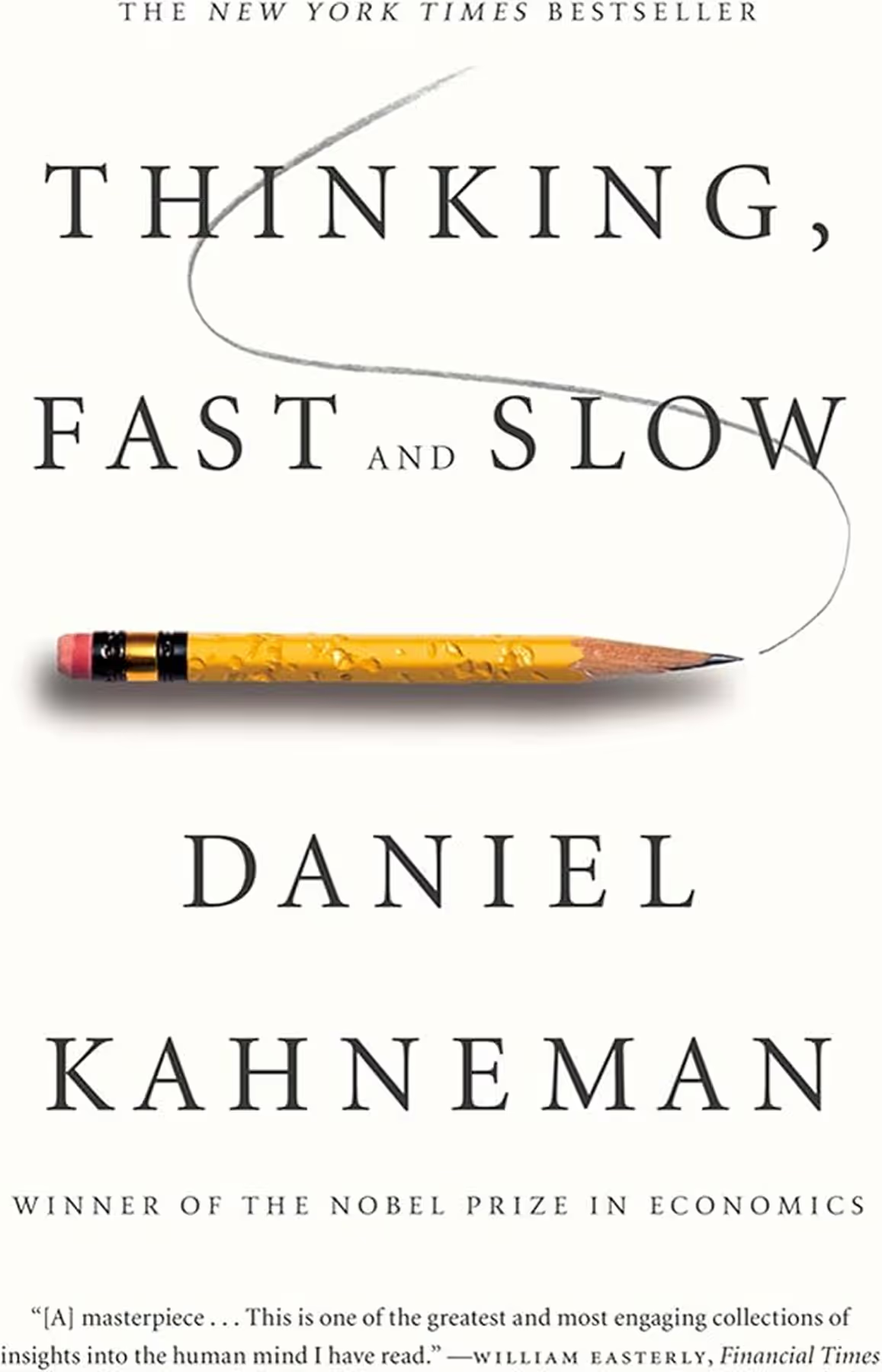
There are two modes in which our minds operate, think, and make decisions. The first way is automatic, impulsive, and intuitive – Kahneman calls it System 1. The second is thoughtful and calculated – System 2.
The lazy mind – our mind and body are always trying to save energy. It’s called “the law of least effort.” But this efficiency (or laziness) can lead to errors and affect our intelligence. To show how the two systems work, the author introduced a problem:
But when we put in some effort and use System 2, we see that the answer is $0.05.
Our brain limits our intelligence when we are being lazy, wanting to avoid System 2.
Priming
The words, things, and concepts we see around us can influence our behavior.
Example: participants in a study were primed with words associated with elderly people (e.g., Florida and wrinkle). They were walking at a slower than usual pace after seeing the words. The participants, of course, didn’t even notice the impact the priming had on them.
Halo effect
When we like one aspect of a person's character, we automatically assume that their other aspects are good too.
Example: if someone is good-looking, talented, or kind, people would often think good of them, even without really knowing them.
The substitution heuristic
When we’re asked a complex question, we often translate it into a simpler question (a cognitive shortcut) to make it easier for ourselves to answer.
Example: if someone asks us: “how successful will that woman candidate be for sheriff?” We automatically replace the question with an easier one, like, “does she look like someone who will be a good sheriff?”
The availability heuristic
We tend to overestimate the probability of something we often hear about or something that makes a strong impression on us. We’re afraid of terror attacks, airplane crashes, etc., although they’re not very probable.
Cognitive ease
You’d be more likely to choose an option or believe a statement that is easier for you to understand. Even the color of the font or its size can make a message more persuasive because it requires less cognitive strain.
Repetition
Messages are more persuasive when we’re repeatedly exposed to them.
Our mood affects our creativity
When in a better mood, the part of the mind that is alert and analytical relaxes. Then, System 1, which is more intuitive and quick-thinking, and responsible for creativity, can take all our energy for play.
Lying with statistics
How we present a statistic can change how we perceive it. We’ll consider a rare event as more likely to occur if it’s expressed in terms of relative frequency and not in statistical probability.
Denominator neglect
Another way to “lie” with statistics is to describe a vivid mental image that will make the reader ignore the actual statistic and decide based on emotions rather than facts.
Both statements are equal, but the second one brings to mind a disfigured child. Doctors who read the second statement were much more hesitant to prescribe the drug.
Reference points
We don’t approach numbers objectively. We always measure them according to a reference point. Rationally, if two people have $5M, they’re supposed to be equally happy.
But if we discover that one of them has started their night at the casino with 9M and the other with 1M, we immediately feel bad for the first person and sad for the second.