🗒️
Note: My notes are a mix of key ideas and quotes from the book as well as my own thoughts.
🎉
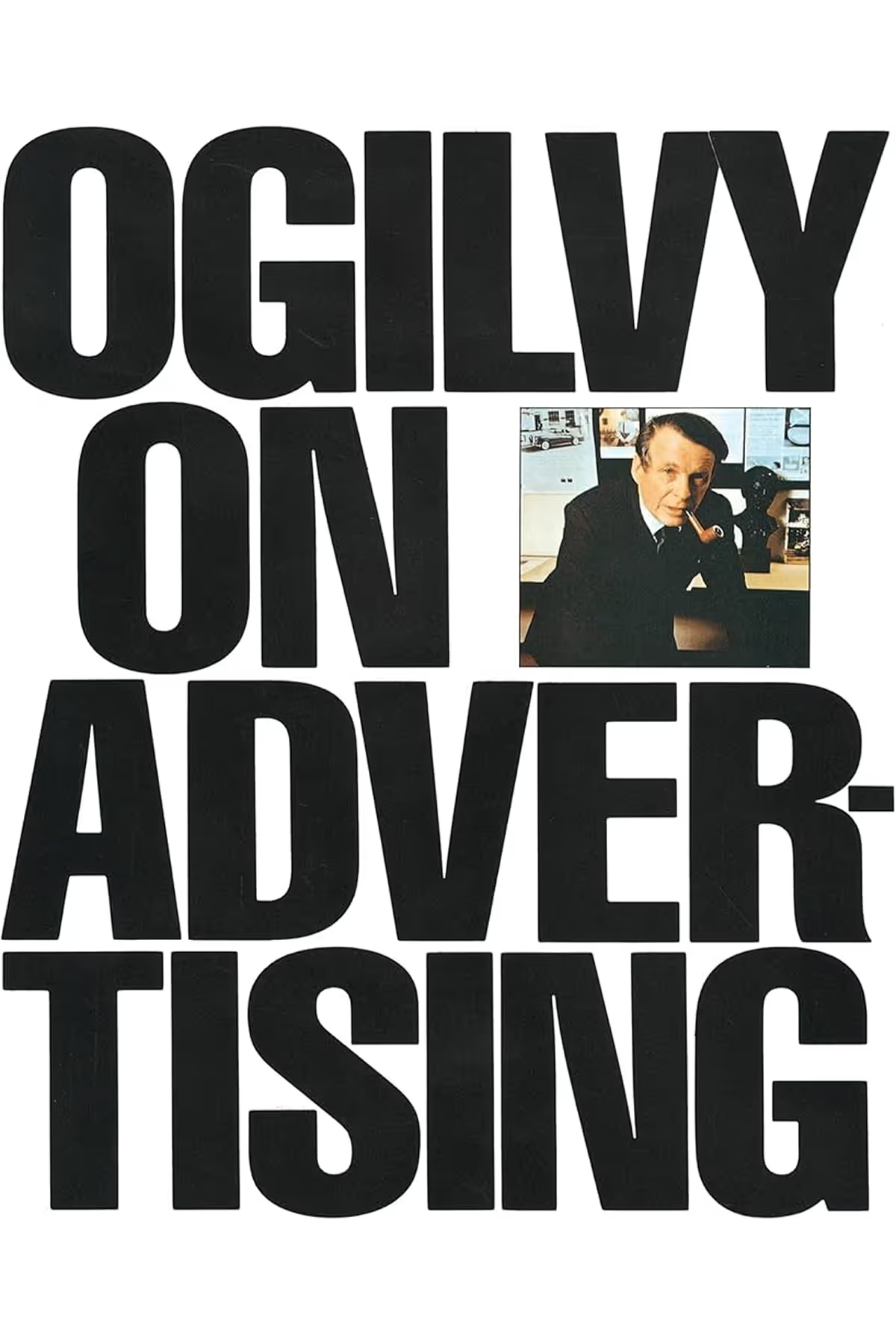
Repeat your winners. You're not selling to a standing army; you're selling to a moving parade. If you write a good ad, don't be afraid to repeat it until it stops selling.
- In ads and business, always call to action. Be the one who dictates the next steps:
- Examples: I'll call you on Wednesday to see when it is convenient for you to meet," "I'm free at this, this, and that time."
- How to recognize a good idea:
- It makes you gasp.
- It makes you jealous.
- It will work in 30 years.
💬
"The ad that sold a fridge to couples who got married last year will sell it to couples who got married this year."
- Don't misspell names.
[Always happens. Even Grammarly can't help you with that.] - The creative's destiny is to live with fear.
"I have never sat down writing an advertisement without thinking: 'this time I'm going to fail.'” - When people aren't having any fun, they don't produce good advertising.
"Get rid of sad dogs who spread gloom."
[And the toxic people who spread poison.] - Go to the meeting if you want things to go your way.
"He who is absent is always wrong." - When writing for a local media channel, mention the city's name in the headline. People are more interested in what's related to them.
[Same for products that solve a specific problem like asthma, hair loss, etc. Always try to narrow down your audience.] - Specific headlines are better than vague, generic statements.
Example: "Sears makes less than 5% profit" by Ogilvy. It's better than saying "less than you'd imagine." - 75% more people read helpful information than just product-focused copy.
Example: How to remove stains → use Tide and follow these easy steps.
One of Ogilvy's favorite headlines:
"Send us your dollar, and we'll cure your piles, or keep your dollar and keep your piles."
- Before and after is a highly effective method to increase sales. But it's not always the cleverest way you can show a benefit.
- As a copywriter, your goal is also to find the right illustration/photo. Make sure your photo or illustration has a fascinating subject. That it tells a good story. If you don't have a story to tell, make the product the ad's hero. Make it look good.
- Do not address your readers as though they were gathered together in a stadium. When people read your copy, they are alone. Pretend you're writing each of them a personal letter on behalf of the company.
- You can't bore people into buying your products. You can only interest them in buying it.
- Long copy might sell better because it has more facts in it. And more facts sell. But make sure that you show the facts as benefits. Also, the first paragraph has to be a grabber, not something generic like: "Going on vacation is a pleasure to which everyone looks forward."
Using famous people and influencers increases customer engagement. Ensure that your audience knows the famous person and that they are relevant to your concept.
A little poem:
"When the client moans and sighs,
Make his logo twice the size.
If he still should prove refractory
Show a picture of his factory.
Only in the gravest cases
Should you show the clients' faces."
🧑🌾
What Ogilvy told people who wanted to use esoteric words in their copy:
"Get on a bus. Go to Iowa. Stay on a farm for a week and talk with the framer. Come back to New York by train and talk to your fellow passengers in the day coach. If you still want to use the word, go ahead."
"Get on a bus. Go to Iowa. Stay on a farm for a week and talk with the framer. Come back to New York by train and talk to your fellow passengers in the day coach. If you still want to use the word, go ahead."
- Social proof. James Webb Young says, "Every advertiser has the same problem: to be believed."
- Testimonials are a good solution. When writing testimonials, take someone credible. Like an old lady. Not some hot guy who's obviously an actor.
[The more authentic, the better.] - Don't be afraid to get inspired. Some would even say copy others. If you write it, your character and ideas will be there whether you want it or not.
- Chameleon ads. Don't make your ad look like an ad. Make it blend into its environment. If it's going to appear in a newspaper, see what the other articles look like and make it in a similar style. Otherwise, people will just skip it.
[The antidote is stand-out ads: ads that look completely different, you can't miss.] - Typography. Don't use capitals too much. They make text hard to read.
🤔
Another mistake is to put a period at the end of headlines. Periods are also called full stops. They stop the reader from reading on.
- Brand campaigns. Advertise your company without relation to any product. It makes people more likely to buy your products when they see them. It also attracts employees.
- Business naming tip. Never use initials (e.g., KLM). You'll spend too much money and time trying to make people remember them and their meaning.
- Thoughts on B2B. Different people in the company make buying decisions. We call them 'buying influences.’
👨💻
Captions. People read them more than the body copy.
- Promise something useful for them, like service, responsiveness, and support. Be specific. Instead of generalities, use percentages, time, or dollars saved. You are talking to engineers.
[We already know that you're speaking to engineers, but most importantly – to humans.] - Advertising for good. Howard Gossage used to say that advertising should exist only because of its power to do good. Even if that's not your purpose, now, with your skills, use any opportunity to do good. It can be a great way to develop your portfolio, too.
- Show the product in the right environment. If the product is for use bathroom, show it in the bathroom, not in a laboratory.
- Provide news about the product. For an old product, we can create news by advertising a new way to use it, like using baking soda to keep refrigerators smelling sweet.
"Products, like human beings, attract the most attention when they are first born." - "Headlines get five times the readership of the body copy. If your headline doesn't sell, you have wasted your money."
- How to create a sense of urgency → limited edition, limited supply, last time at this price, special price for the early-bird
🗯️
Advertising which promises no benefit to the customer does not sell, yet most campaigns contain no promise whatsoever.
- A/B testing. And testing in general. Recommend to your clients two headlines that promise different things about the same product, and ask them to test which works the best.
[Buzzfeed is the master of A/B testing. They test like ten different headlines for each piece of content.] - Pricing. No one has the best scheme. It's a matter of trial and error. But a rule of thumb is that consumers prefer superior products at a premium price.
[Relevant tip for freelancers.]
Human nature. Bill Bernbach: "Human nature hasn't changed for billions of years. It won't even vary in the next billion years. Only superficial things have changed. It is fashionable to talk about changing man. A communicator must be concerned with unchanging man: what compulsions drive him, what instincts dominate his every action, even though his language too often camouflages what really motivates. For if you know these things about a man, you can touch him at the core of his being. One thing is enchantingly sure. The creative man with an insight into human nature, with artistry to touch and move people, will succeed. Without them, he will fail."
[Amen. Reminds me of Warren Buffer's approach to investing, ‘don't try to guess what will change. Instead, think what will always remain the same.’