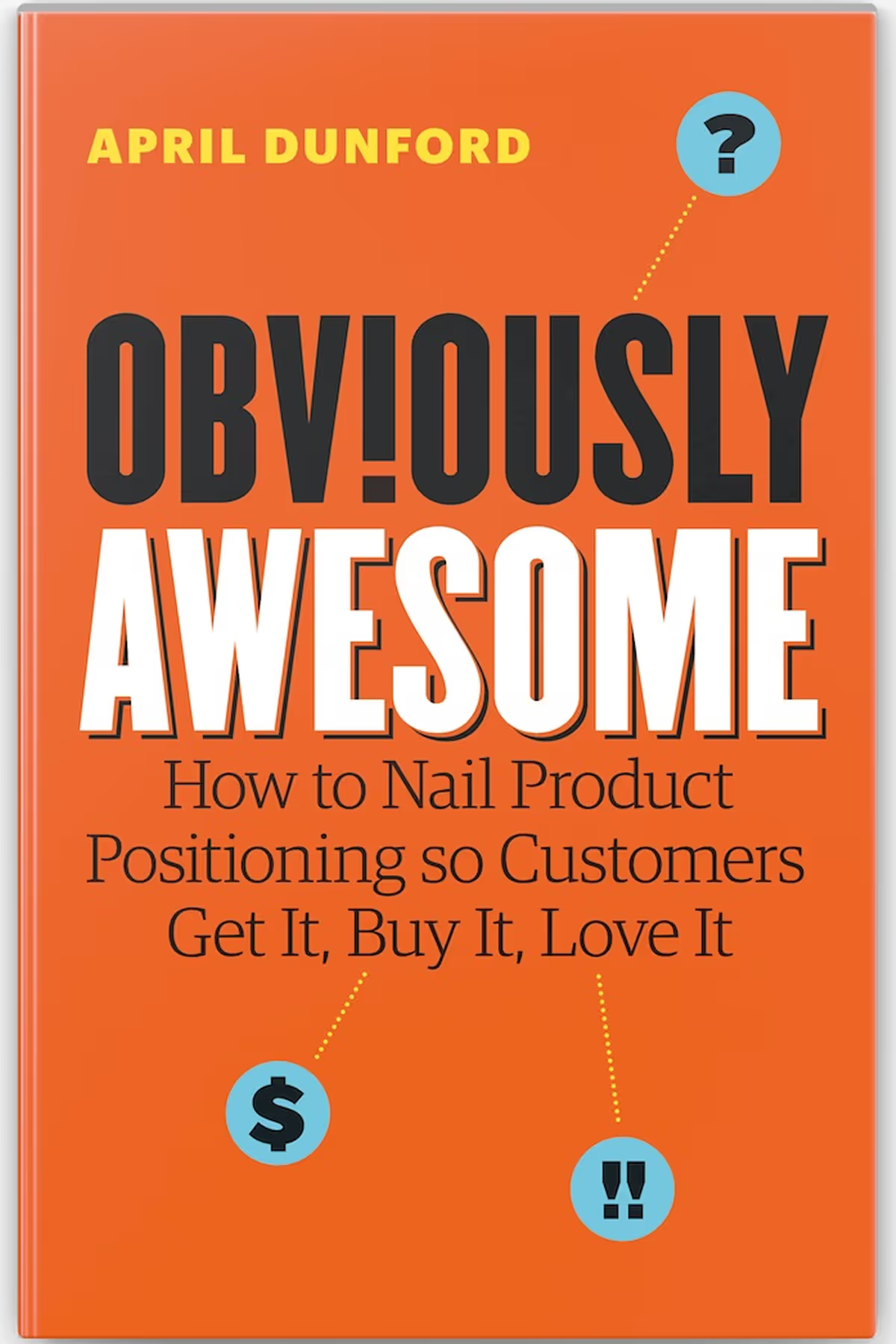
- Positioning is the foundation of every ad, sales pitch, and piece of content we create.
- It is the key to the success of the business itself.
- It gives our customers a reference point regarding our product.
- It helps them understand to which category it belongs and what parameters they should consider when evaluating it.
- Most products are exceptional only when we understand them within their best frame of reference.
How to know that you have a positioning problem:
Your current customers love you, but you’re struggling to sell to new prospects.
Customers often leave or ask for new features. They misunderstood what you’re doing, and now they want to recover the money they paid.
You have long sales cycles and low close rates.
People do not understand your real value, so they’re not satisfied with the price.
Prospects and customers describe your business differently than how you see it.
Common positioning mistakes:
Thinking that there’s only one way to position your product. There are always plenty of ways you can look at it.
You’re stuck on the idea of what you were planning your product to be without noticing what it has become in reality.
Market confusion: when we as product creators understand the product differently from how customers perceive it.
You created your product for a specific market, but while you were busy working, the market has changed. Most products can solve many different problems. Many products had been sold for one purpose, but when the market shifted, their purpose (and positioning) changed as well.
Ask yourself: is the history of my product and the way I describe it exist in my marketing today? If yes, ask yourself what has changed since then. Maybe those things aren’t relevant anymore.
Source
aprildunford.com/post/a-product-positioning-exercise
Main topics that positioning covers:
The key components of positioning:
| Step | Action | Details |
|---|---|---|
| 1 | Competitive solutions | If you didn't exist, what would customers use? (Use XLS or Google Docs instead; might as well be "do nothing and suffer") |
| 2 | Unique attributes | What features/capabilities do you have that alternatives do not? |
| 3 | Value and proof | What value do the attributes enable for customers? What proof of that value do you have? (Only testimonials and expert opinions count as proof of value) |
| 4 | Target market characteristic | Who cares a lot about that value? |
| 5 | Market category | What market do you describe yourself as being part of? (Your market category is the context that makes your value obvious to these target customers) |
| 6 | Trends | What trends make your product relevant right now? These should be trends your audience cares about — they help make your product more relevant and attractive. (e.g., NFTs, Pantone color of the year, sharing economy, etc.) |
| Step | Action | Details |
|---|---|---|
| 1 | Competitive solutions | if you didn't exist, what would customers use?(use XLS or Google Docs instead; might as well be “do nothing and suffer”) |
| 2 | Unique attributes | what features/capabilities do you have that alternatives do not? |
| 3 | Value and proof | what value do the attributes enable for customers? What proof of that value do you have?(only testimonials and expert opinions count as proof of value) |
| 4 | Target market characteristic | who cares a lot about that value? |
| 5 | Market category | what market do you describe yourself as being part of?(your market category is the context that makes your value obvious to these target customers) |
| 6 | Trends | what trends make your product relevant right now? These should be trends that your audience is interested in. They can help make your product more relevant and attractive.(e.g., NFTs, Pantone color of the year, sharing economy, etc.) |
- To identify your main audience, ask yourself if I had to make as many sales as possible TODAY, who would you go to first? What are their problems?
Example: A bank with a big database that needs to analyze quickly. - The market category you chose always comes with a list of assumptions and stigmas. Pick the wrong category, and you’ll spend lots of time and money breaking those stigmas. On the other hand, the right category can save you plenty of money and explanations.
The 10-step positioning framework
How to implement your new positioning:
- Even before you create any ads, come up with a sales story; define what a presentation of a sales team will look like.
- Start with the current solutions.
- Then show what should happen in a perfect world, where the current solutions don’t provide.
- Then show your solution.
- And finally, present the value your features provide and the proof-of-value (testimonials, a case study, and answers to common objections).
- Positioning needs to be updated once in a while:
- Outside forces like new competitors, existing regulations, and new technologies can force you to adjust your positioning.
For example, if you’re a regular airline company, but then a new low-cost competitor enters the market, you may have to position yourself as a premium airline or drop your prices.
- Outside forces like new competitors, existing regulations, and new technologies can force you to adjust your positioning.
- Summary
Any product can be positioned in multiple markets. Your product doesn’t have to be stuck in a market where no one understands how awesome it is.
Great positioning rarely comes by default. You have to do it intentionally if you want to succeed.
Understanding what your customers see as the alternative to your solution will lead you to your differentiators.
Position yourself in a market that makes your strengths obvious.
Use trends to make your product more interesting right now. Don’t lay on a trend just for the sake of it. It has to make sense.